Vilamoura – Loulé · Quinta do Lago · Lagos
489 Moroccan listings — 439 of them for sale — anchored by Marrakesh: riads in the medina, estates in the palm groves, through the Christie's International Real Estate network.
International desk — one advisor answers every Morocco inquiry
Morocco earns its place in a second-home portfolio on a simple equation: genuine cultural depth at a short flight from every major European city, with a cost of ownership that markets like Provence or Tuscany left behind decades ago.
The center of gravity is Marrakesh, and our network's 489 Moroccan listings reflect that — 439 for sale and around 50 available to rent. This is where international buyers have restored riads, built garden estates, and established a service economy that supports absentee ownership well: managers, gardeners, cooks and drivers are available, affordable and professional, which is the practical reason a house here gets used rather than visited twice a year.
It is also a market where local knowledge is not optional. Title practice, restoration standards, and neighborhood character vary street by street in the medina and estate by estate outside it, and a riad two doors from a good one can have a different access situation, a different structural history and a different set of neighbors. That is what the Christie's affiliate on the ground is for, and it is why we confirm the legal status of each property individually rather than describing the country's rules in general. Tell us whether you are drawn to the old city or the space beyond its walls, and we will shape the search accordingly.
Marrakesh runs on a rhythm foreign owners either take to immediately or never quite settle into. Mornings are for the souks and the gardens, the middle of the day belongs to the courtyard, and the evenings run late. The seasons are pronounced: spring and autumn are close to perfect, winter is bright and cool with snow on the Atlas an hour away, and July and August are genuinely hot, which is why the Palmeraie's pools and the coast at Essaouira exist. Flights from London, Paris, Madrid and Milan are short and frequent enough that a four-day visit makes sense, and that is the single biggest reason European owners use their houses here more than they expected to.
Three purchases, and they are not variations of each other. The riad — a courtyard house inside the medina walls, reached on foot, priced on the quality of its restoration and the light in its courtyard. The villa in a gated estate or golf development outside the walls, which is the straightforward, serviced option and the one most families choose. And the garden estate in the Palmeraie or the Ourika road foothills, where land, mature planting and water infrastructure are the asset and the house is what sits on it. Each has a different diligence checklist, and the mistake buyers make is applying one to another.
Marrakesh is the market: the medina's courtyard riads, the Ville Nouvelle's twentieth-century villas, and the gated golf and resort estates on the city's edge, all under the Atlas Mountains. Buyer profiles differ sharply between those three, and so do due-diligence questions — a restored riad and a new-build villa are different purchases in almost every respect, from how you get to the front door to what it costs to keep the roof on. Within the medina, the difference between a well-connected derb and a difficult one is a practical question about deliveries, parking and the last hundred meters, not an aesthetic one. Our affiliate's role is to match the property type to how you will actually use it, then vet the specific asset hard.
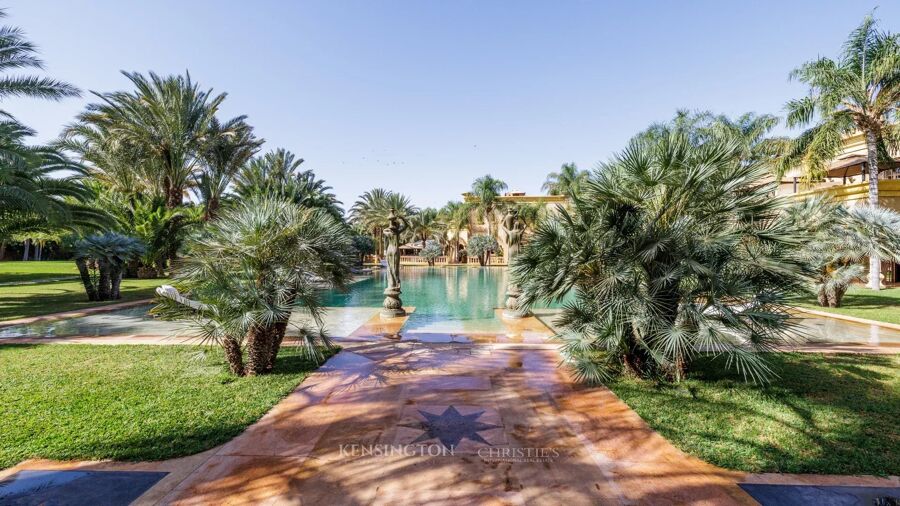
The Palmeraie is Marrakesh's historic palm grove turned estate district — large walled properties with mature gardens, pools, and staff quarters, minutes from the city but private in a way the medina cannot be. It suits owners who want Marrakesh as a base for entertaining and family stays rather than a pied-à-terre, and it is where most of the city's largest houses sit. Land size and water infrastructure are the variables to scrutinize here: the grove is not uniformly watered, planting of that maturity depends on a functioning supply, and a garden is far more expensive to restore than a building. We make both part of every evaluation, along with the road access, which varies more than the addresses suggest.
Tangier is the surprise of the Moroccan book at 38 listings, and it is a completely different proposition from Marrakesh: a port city on the Strait of Gibraltar with Spain visible across the water, a European history layered into its architecture, and a sea breeze that makes summer livable. A decade of port, rail and marina investment has changed the city's trajectory, and the residential market has followed — apartments and villas on the hills above the bay, houses in the old kasbah, and new-build along the coast road toward Cap Spartel. For European owners the practical argument is proximity: this is North Africa within sight of Europe, with a ferry as well as an airport. Casablanca, the country's commercial capital, carries a further 29 listings and behaves like a business city rather than a second-home market. Essaouira on the Atlantic remains the one we are asked about most and hold least — six listings, and worth a conversation rather than a search.
Heading: Medina riad or garden estate?
Subline: Tell us how you picture your time in Morocco — we will answer with real properties and an honest read on each one.
Closing band: The souk at dusk, the Atlas at dawn. Start the conversation.
These are the properties in our own feed, not a network-wide total, and they move every night. All information is deemed reliable but not guaranteed and should be independently reviewed and verified.
They are live in our search today, and a specialist can send the current shortlist - including the homes that never reach a public page.
Tell us what the house is for and what you have already ruled out. We will tell you what is actually available, including what is not on a public page.
We reply to every inquiry personally. No automated drip, no list sale.